



It were some basic descriptions on where to place your service in order to know where you can expect the next shot back again.
There are a couple of things you need to know about our sport to understand how you can predict what will happen. The things that have been written about this before are nice but not what it really comes down to and that is the position of the racket, where you hit the shuttle in relation to your body position.
The position of the racket is what makes badminton predictable. When you take the things that some writers on this site have been saying about this subject and you take it to the next level you get to the hardcore point.
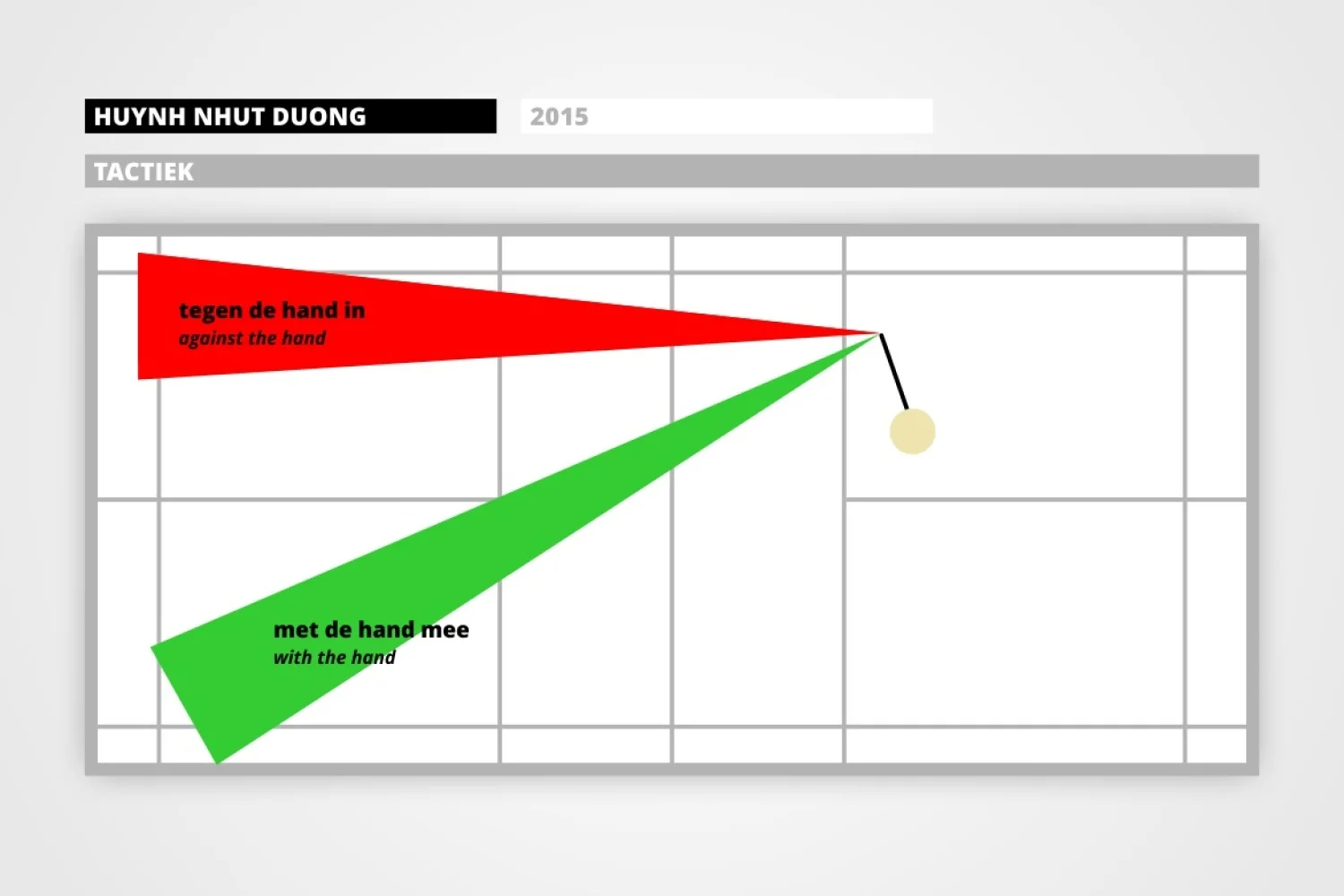
Predictable badminton is nothing more than using the most logical physical possibilities available and it starts with playing 'with' and 'against' the hand. To play with the hand is to follow the natural movement of your arm to hit the shuttle, whereas against the hand you have to change the angle of your racket towards you arm to hit the shuttle to play the shuttle in the none natural direction.
Shuttles you can hit in front of your body will give a cross shot when you play them with the hand. If you want to play them long line you have to correct the angle of your racket and thereby play against the hand. The shots in front of your body are in general soft shots without too much pressure. Where the shots come with more pressure the reaction time is less and you will take the shuttle later in its flight. Now the angle of the racket position towards you body changes and thereby also the result of playing 'with' the hand.
When you can no longer hit the shuttle in front of your body and now take the shuttle next to or past the body line the 'with' the hand shot changes from cross to long line and the cross shot is now an 'against' the hand stroke.
Most players on semi top level play the shuttle back without thinking and therefor will play automatically strokes with the hand. These are also the most fast strokes and have more power than the strokes against the hand. Strokes against the hand are technically more difficult and you have to make the choice to play a stroke like that. You can say that strokes with the hand are made subconsciously and the ones against the hand are done consciously.
90% of the time players are not playing conscious and don't follow a tactical plan, therefor are also most of the strokes with the hand. This is also the reason why strokes against the hand are so good to use for deceptions because most players want to move to positions that are in the path of with the hand.
Also the place where the shuttle has been played is important. A long fast drop past the service line will give you a lob as return and almost never a net drop and because the shot is played fast it will come back has a long line lob because again it is the stroke that is played with the hand.
If the drops getting shorter to the net the rules from with and against the hand do no longer apply. About the situations at the net I will write some other time, because it also involves some contradicted grip changes that are not used a lot in Europe.
Examples predictable badminton in the service on the right side of the court with a right handed player are mostly for double situations. Please remember that these are NOT rules. It is just most likely to happen with some logical explanations.
Yellow: this is the most used service in doubles. It will give in 90% half cross shots as a return and can be taken with both FH and BH grip. All BH grips have the with the hand situation to the left side of the opponent and with the FH to the right side. It is however very easy to play against the hand in both situations so every side is possible and there is a very good option for deception this way. In the yellow field it is also possible to kill the shuttle if the service is a little too high.
Green: here the service starts to come on the FH side and a little away from the player, a very short service will result in a with the hand stroke and that will be a cross in most of the situations. If the service is a little longer it is very well possible that the shuttle will not come cross because the with the hand situation has changed, so long line is a good option now specially as a deception shot. The cross is also in tactic the best option because from the green position you are very close to the middle of the court with a BH defense. A lift to the right side of the court will open the FH defense with a lot less options. Play to the left side of the court is possible but the element of surprise is very important so deception have to be used.
Red: this is the short service to the outer side of the court, a short return is the most logical return if you are not too late in the reaction, a cross shot is no option also because you open your side of the court too much in that situation.
Orange: again a little longer service to avoid a net return and give to possibility for the attack, a service here will give a long line opening in de back part of the court.
This article is not for elite players, we use it in Denmark on second division level ladies doubles. At this level in the mens doubles you can already see that there are exceptions to these rules. The better players will recognize your tactic but on junior level and until second division Danish level you can use it with success. I also do realize that this article is very short and that there is a lot more to be said about it, I just wanted to start the discussion on predictable badminton and I hope you see it as a start.
Duong Nhut Huynh
Reacties 4
Great Huyhn, it's short but clear, and actually gives most players and coaches a lot to think about in a short while.
A good coach can immediately get one rule out of this that maybe applies even better on singles than on doubles (Spoiler: i mean the one with the fast long line drop...this works even better in singles, but there you also have to take into consideration the possibility of the net, but that's actuallly the shot that I would like to have, but the most important thing then becomes the footwork the single player has to use...
Hopefully one of the coaches or players reading here, thinks about this, and maybe we can talk about it here, it would be nice. I have a strong preference for some positions and footwork after a fast straight dropshot in singles from the FH and the ATH side.
Again nice to read from you and looking forward to seeing you!
Bedankt voor het antwoord en de uitleg die je geeft over de probatie en supinatie bij bh en fh uitvoering in combinatie met 'met de hand' of 'tegen de hand inspelen'. Ik begrijp nu beter hoe de draaiingen in de arm werken in welke situatie; welke beperkingen daar uit voort vloeien, waarmee voorspelbaarheid wordt gecreerd. Met name dan op de bh-kant, aangezien tegen de hand in spelen bemoeilijkt wordt doordat de bovenarm beperkt kan draaien.
Het is een aardige vraag waar het antwoord iets meer complex
is dan dat je zou denken. De vraag gaat niet erg in detail en dat zou wel
moeten want er gebeuren een aantal belangrijke dingen in deze situatie.
Grond principe als het gaat over pronatie en supinatie in
onze slagen: Deze bewegingen worden voor het lichaam uitgevoerd. Dus de vraag
gaat enkel en alleen maar over de hoek die ontstaat door je eigen keuze om met
de hand mee of tegen de hand in te spelen, want het gebeurd alleen maar voor je
lichaam en als de shuttle pas word geraakt als het de lichaam lijn is
gepasseerd dan geld het principe van de pronatie en supinatie zoals we die
kennen niet meer omdat deze zich van de onderarm naar de boven arm verplaats en
dan hebben we het over een hele andere techniek.
In de natuurlijke beweging (met de hand mee) is de rotatie
vrij klein, we hebben het over een halve draai van de onderarm en een minimale
rotatie van de boven arm. Tegen de hand in echter vraagt om een extreme rotatie
van de onderarm, deze word naar het extreme gevoerd door het mee roteren van de
bovenarm in de FH kant en het optillen:naar boven bewegen van de elleboog. Op
de BH kant ligt de supinatie beweging erg natuurlijk, maar ook hier geld de
regel dat hij niet meer gebruikt word zodra de shuttle de lichaamlijn is
gepasseerd. Zowel op de FH als de BH is de rotatie met de hand mee minder dan
tegen de hand in, tegen de hand in bij de BH heeft een tegen over gestelde boven
arm rotatie dan op de FH kant en je elleboog zal dus juist voor je lichaam
komen en naar beneden wijzen. De bovenarm rotatie is ook minder extreem omdat
in tegenstelling tot de FH de schouder niet naar voren gebracht kan worden, het
lichaam zelf geeft hiermee de beperking aan.
De conclusie is dus dat de hoek van de shuttle en het
lichaam niet van belang zijn, het gaat om de keuze tussen met of tegen de hand
in die de mate van rotatie pro en
supinatie bepaalt. De rotatie is minder met de hand mee en daarmee ook meer
natuurlijk, tegen de hand in is dus ook als je naar de pro en supinatie kijk
een meer moeilijke uitvoerbare beweging en ook meer tegen natuurlijk. Dat past
weer helemaal in het beeld dat in die artikel word gegeven van de voorwaarden
van met de hand mee en tegen de hand slaan van de shuttle.
Very nice article!!! With 'natural movement of your arm' you mean the forearm rotation, either pronation (forehand) or supination (backhand)? And the forearm rotation in combination with the angle of the shuttle and the body makes the 'with the hand' or 'against the hand'?
Reacties zijn afkomstig uit de periode dat badmintonline.nl Disqus gebruikte als reactiesysteem.